Reproducible planning calculation
Wireless calculation explorer
Inspect the two-hop design and see how antenna height, frequency and radiated power change the result.
This tool recalculates the sampled path and RF budget locally. These are predictions. Device capability settings do not establish permitted operating power. The retained terrain dataset has 61 samples per hop and does not resolve every building or tree.
Sampled terrain and 60% Fresnel envelope
Device-specific MCS budget
20 MHz, 800 ns guard interval. MCS0–7: one stream; MCS8–15: two streams. Margin includes 2 dB other loss. A 50% payload factor is assumed; interference is excluded.
| MCS | TX dBm | EIRP dBm | RX dBm | Threshold dBm | Margin dB | PHY Mbps | Payload estimate Mbps |
|---|
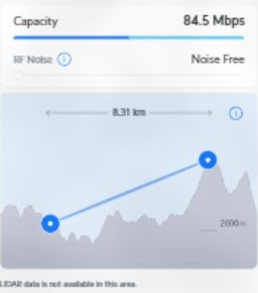
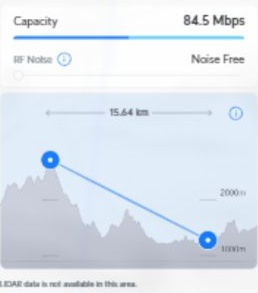
Authentic UISP results
Actual captured outputs use different frequencies, automatic TX power and vendor assumptions. Their 84.5 Mbps capacity is a prediction under the Noise Free setting. LIDAR data was unavailable.
What this calculation can establish
A positive sampled clearance and budget margin justify survey and field comparison. They cannot certify mast structure, local interference, legal power, payload throughput or annual availability. The Monte Carlo screen in the report is a separate set of assumed scenarios and is not recomputed by this explorer.
Download reviewed results JSON · Download all nominal MCS budgets · Model and sources